Showing posts with label engagement. Show all posts

Monday, July 11, 2011

Employee Engagement Indicator

A popular concept for many of today’s organizations is employee engagement. There is a plethora of information available on the topic; a Google search resulted in over 3.5 million hits. In researching employee engagement as part of my doctoral program, I was somewhat surprised to learn that a wide-variety of definitions exist. Each individual, from consultants to scholars, has his/her own definition – while quite similar when talking employee engagement there is no guarantee everyone is speaking about exactly the same thing. A colleague of mine presented it as everyone talking about apples but some are focussed on Gala and Fugi while others are talking Granny Smith and Red Delicious. The differences may be slight but can still cause confusion and misunderstanding. In our work helping organizations increase engagement, often through career development initiatives, we first recommend establishing or adopting a definition which resonates with the team.  At Life Strategies we’ve adopted a four-factor model of engagement:

Alignment – fit between individual and organizational values
Commitment – loyalty and intent to stay with the organization
Contribution – level of discretionary effort employees are willing to make (i.e., going above and beyond). 
Appreciation –awareness employees are valued and their effort to support the organization’s goals is appreciated

In seeking to measure engagement along these four factors, we developed the Employee Engagement Indicator (EEi). The EEi is a 40 question survey with 10 questions per factor. The total score is intended to indicate an overall level of employee engagement on a continuum from full disengagement to full engagement.  Sub-factor results can also be analyzed (e.g., level of contribution).

While we are still researching the psychometric properties of the EE-i, preliminary results have been interesting and have demonstrated how a low score on one of the factors can drastically impact overall engagement results. Interested in using the EE-i with your own team? Contact us at info@lifestrategies.ca for more information.

Tuesday, June 28, 2011

The Synergy of Teams


People are constantly asking me how I do all that I do – my response invariably is that “I have a great team!”

At its simplest, synergy is defined as “two or more things functioning together to produce a result not independently obtainable.” Research has demonstrated that synergistic teams can out-produce even the most talented member – and we’ve seen that over and over within the Life Strategies teams.

There is strength in diversity – at Life Strategies, we deliberately build teams that comprise individuals with different competencies and styles. This, of course, means that we all have to embrace and appreciate diversity. Sometimes it’s easier to work with people who approach tasks the same way or share a very similar perspective. However, by choosing to surround ourselves with people who see the world differently and bring unique skills and talents we minimize our blind spots and maximize our productivity.

Do you really know the strengths and talents on your team? Do you let people do what they do best . . . and try to accommodate their weaknesses? Or, are you trying to do too much independently – spending hours at tasks that others could do better in a fraction of the time?

Tools like Personality Dimensions® can help you better understand the teams you work with – whether at work, in athletics, or on community boards. Most members of the Life Strategies team are Personality Dimensions facilitators or Master Trainers . . . aside from facilitating workshops, though, we all walk our talk – celebrating the diversity on our team and providing opportunities for each other to do what they do best. Contact us at info@lifestrategies.ca if you’d like to introduce your own team to this amazing tool.

Wednesday, June 15, 2011

To Grow is to Change . . .


"To grow is to change, and to have changed often is to have grown much." - Cardinal Newman

This is one of my favourite quotes . . . I have it in my e-mail signature line and framed on my bookshelf. I love change, I’ve changed often, and I continue to grow much (in more dimensions than I’d prefer, at times!). That said, change can be exhausting!

Did you know that there’s a cumulative effect from change? Psychiatrists Holmes and Rahe developed the Stress Scale, a tool that ranks life changes according to the amount of stress they are believed to bring. Although stressors don’t impact everyone in exactly the same way, this scale can be a useful starting point to see if your stress levels are creeping into the danger zone (I don’t think mine have ever been out of the danger zone since I entered adulthood – so other important things to measure are coping resources and resiliency; luckily, I’m blessed with high scores for both of them, too!).

Continuous, relentless stress, though, can lead to burnout. If, like me, your work and life bring constant changes, ensure that you’re adding in extra de-stressing moments to compensate. Gerry and I are about to leave on my 12th trip in the past 6 months. We’ve actually gone through more toothpaste in our travel bag this year than in our bathroom at home! We both love travel . . . but there’s no denying that it’s stressful. Therefore, we try to add on a few days to each trip that are just for us – to visit friends or family, tour the local area, or simply have time with no agenda other than to recover from jet lag, get adjusted to the climate, and find our way around the local neighbourhood.

Psychologist Nancy Schlossberg developed a 4S model to explain individual differences in coping with transitions (the process that accompanies life changes). She found that one’s Situation, Self, Support, and Strategies together impact how people respond to exactly the same event (or non-event – an anticipated event that doesn’t happen, such as a missed promotion or a broken relationship prior to a marriage). For example, as I contemplate re-packing the suitcase that I just unpacked a few days ago, although I’m definitely tired of travel right now (and looking forward to a summer in my own garden), I recognize that my Situation is very privileged in that I get to choose whether or not to travel and have incredible flexibility in deciding how long to be away. In terms of my “Self” – I’m healthy, very comfortable travelling, fascinated with different cultures, insatiably curious, and able to quickly convert a hotel room into a temporary home. Because Gerry travels with me, I have the same Support as when I’m home; I’m also blessed with an amazing team at Life Strategies who have become quite used to working with me through MSN chat and e-mail. In terms of Strategies, we’ve booked our flights so that we arrive a few days before the conference, and then spend a few days on vacation before returning home.

As you reflect on your own change, growth, transitions, and related stress, consider how to minimize the negative impacts of change and strengthen your resiliency and coping resources – both strategies can be effective.

Friday, May 27, 2011

Immigrant or Expatriate? There's a Difference

Some people think that anybody working in Canada who’s “from away” is an immigrant – but that’s not always the case. However, we rarely think of Canadians working abroad as having emigrated (i.e., left Canada permanently). Instead we consider them expatriates. This is an interesting shift in perspective, with all sorts of career/life implications.

Expatriates, international workers, or global careerists typically live a somewhat privileged lifestyle compared to locals; immigrants, on the other hand, typically struggle to get their careers back on track. Ironically, so do some people repatriating to Canada – although their careers may have blossomed abroad, similar to many immigrants they have a hard time convincing local employers that their international experience is of value.

Within Canada and many developed countries, when someone new to the country requests career services, there is often a focus on language training, skills upgrading, and, in some cases, complete re-careering. It’s not unusual to find an immigrant with a PhD driving taxi or serving in a restaurant. I once had a medical doctor from Afghanistan tell me that, upon arrival in Canada, he’d been told that he would have to work as a dishwasher here!

It astounds me that anyone would be surprised when a foreign-trained worker leaves Canada for better opportunities somewhere else. If I was to emigrate from Canada (i.e., immigrate to another country which was to be my permanent home), then it would be worth my time to learn the language and customs, upgrade my education, gain local job search skills, and take a survival job as I settled in. On the other hand, if I were to go to a foreign country where I'd heard that they needed people with my existing professional skills (e.g., teaching counselling in a university; corporate training for a multinational corporation), if I couldn't get that type of work within a very short period of time after arrival, there'd be no point in staying. I'd move to another country that could use my skills.

International/global careerists change countries in a similar way as people in a large city take on new jobs throughout the region. Within the Vancouver area, for example, someone might accept a job offer in Burnaby even if he or she lives downtown. The individual may commute rather than move to Burnaby. Even if a decision is made to move to Burnaby, once the contract is finished it’s quite likely that he or she will move again for the next job. So too, international workers go where the work is. They may leave family behind or families may relocate temporarily; children may attend local or international schools. Leisure time may be spent with other expatriates, groups from “home,” locals, or a combination.

Unfortunately, in Canada, we tend to view all people with foreign accents as "immigrants." However, the needs and expectations of immigrants are significantly different from the needs and expectations of people with international careers (or expats). Interested in learning more? Life Strategies offers relevant courses for career practitioners on The Immigrant Experience and International/Global Careers. Contact studentadvisor@lifestrategies.ca for more information.

Wednesday, February 9, 2011

Workplace Conflict


Conflict can be distressing in the workplace. A quick Google search for “workplace conflict 2011” revealed almost 59 million hits, including recent research from the UK, courses in Canada and Australia, blogs, headlines about workplace violence, and articles targeted to diverse industries and organizational structures. Workplace conflict is a hot topic!

In many cases the conflict is amongst co-workers or between employees and their managers and someone from the Human Resource department may be called in to intervene. Left to simmer too long, minor workplace conflicts can boil over, resulting in toxic workplaces, bullying, mobbing, or, in extreme cases, a violent counter-attack as in the Calgary story from just last month, where an employee, frustrated over a disagreement about expenses, rammed a semi-trailer into his employer’s truck. Witnesses reported, “He was distraught . . . he could have done anything!”

In other cases, however, conflict initiates with dissatisfied customers or disempowered clients. Regardless of the issue or who the players may be, de-escalating conflict is an important skill to have. We’ve recently uploaded 10 Tips for De-Escalating Conflict and it’s a key component of our customized workshop for case managers on “Dealing With Challenging Clients.” Tips focus primarily on managing yourself – the only person in the conflict that you really have any control over!

Join us online for our new online certificate program for Case Managers, beginning February 16th!

Thursday, February 3, 2011

Leadership Lessons

The most recent edition of the Life Strategies News highlighted 10 Leadership Lessons for Transformational Times. Each of the lessons was adapted from our recent workbook of the same name and outlines such things as Ignite Employee Engagement, Make Time for Transformation, Embrace Diversity, and Show Appreciation.

During transformational times, organizations are likely to be shifting priorities, adjusting goals, and struggling to be responsive. The tendency, during these periods of uncertainty, might be for leaders to communicate less. After all, what can be said about a vision for the future when the future is uncertain? It is in these times, however, that open communication is most important.

Through a study conducted in 2004, the Hay Group found that “Trust and confidence in top leadership was the single most reliable predictor of employee satisfaction in an organization" (Source: www.nwlink.com/~donclark/leader/leadcon.html). The report went on to note that effective communication regarding the company’s vision, and how each employee contributes to organizational success, are key components of earning the trust of employees. Going silent or waiting until there is something to announce should be avoided at all costs. Great leaders don’t shy away from difficult conversations; instead they communicate organizational challenges and what they feel the future might be.
John Kenneth Galbraith once said, “All of the great leaders have had one characteristic in common: it was the willingness to confront unequivocally the major anxiety of their people in their time. This, and not much else, is the essence of leadership.”

It could be said that British Columbia’s career development sector (particularly the portion of the sector offering services via government funded programs) is currently going through a “major anxiety.” Now more than ever, organizational leaders must instil trust in their workforce by communicating plans, exploring other opportunities, and preparing employees for life beyond business transformation.

Friday, December 24, 2010

Take the Time to Appreciate

As the holiday season is here, it’s important to take time to reflect on the people in our lives – family, friends, and co-workers – and truly appreciate the things they do for us; whether they are big or small. The positive impact others can have is undeniable, and far too often we neglect to say thanks or express our gratitude.

Appreciation is an important component of building positive relationships. It is not only the third component in our Let’s CHAT! coaching model, introduced in previous posts, but it’s also a key factor of employee engagement. Including appreciation into these models helps remind employers and employees to take the time to be grateful for the contributions and commitments of others, rather than focussing solely on the negative or areas that could use improvement.

Take a moment to reflect on who in your office (or life) has helped you. Who’s an un-sung hero in your workplace that could use some appreciation?

See http://humanresources.about.com/cs/rewardrecognition/a/appreciation.htm for some ways to say thanks this season and throughout the year.

Saturday, October 23, 2010

Value/Goal Alignment - An Important Component of Employee Engagement

Some of our recent entries have introduced factors from our model of employee engagement – Appreciation, Contribution, and Commitment. The remaining factor – Alignment – relates to the need for workers to align their values and goals with the organization.

A wide range of career development literature exists which outlines the importance of connecting personal values with organizational values. The popular Wheel framework (Amundson & Poehnell) lists values as one of eight factors to consider in career decision making. As career practitioners, we are very aware of the importance of values when it comes to career “fit.” Whether through formal standardized “tests” or informal checklists and card sorts, we encourage clients to reflect on their values and ensure their work (i.e., specific job/tasks) and/or their industry or employer of choice will share those values. Or, at least, not impede on those values to any great degree.

Alignment of personal and organizational goals is just as important. As individual workers, we set goals for our careers – from wage increases or promotions to achievement of educational goals or industry certifications. Do we ever consider, however, whether those goals make sense when aligned to what our organization is hoping to accomplish? For organizations, this notion of alignment is often called goal cascading – goals are cascaded down from leadership to management to department, to work teams or units. From an employee engagement perspective, however, it’s important to take one more step – checking in with individual employees to ensure that they each understand how their jobs align with organizational goals.

Consider your organization’s future goals, vision, or strategic direction. Is there alignment with your personal and professional goals? If not, explore any disconnect. While you may be able to influence your organizations’ goals, if you don’t find sufficient alignment it may be time to examine whether or not your personal and professional goals can be met within the context of your present workplace. Organizations benefit from engaged employees – if there isn’t alignment between you and your organization, it will be increasingly challenging to stay engaged. You may need a better understanding of your organization’s goals and direction in order to get excited and buy-in. However, if the new direction simply isn’t a good fit for you, it may be time for a gracious exit. Either option is good career management.

Tuesday, October 5, 2010

Commitment in the Workplace

In previous blogs we’ve highlighted appreciation and contribution, but why include commitment as an element of career engagement?
These two quotes speak to the importance of commitment:
“Unless commitment is made, there are only promises and hopes... but no plans.” --Peter F. Drucker
"Individual commitment to a group effort -- that is what makes a team work, a company work, a society work, a civilization work." --Vince Lombardi
Several weeks ago our blog talked about appreciation and it’s important for leaders to understand the relationship between appreciation and commitment. It appears that employers, rather than employees, are tasked with the job of appreciation. Employees need to know that their employer will go to bat for them and respect their well-being. However, workplace commitment expands on the concept of appreciation in that it is a two way street: not only do employees need to know their employer is committed to their well-being at work, employers want to see examples of workplace commitment in employees.
Gone are the days when employees would spend their entire working life with one employer. Does it follow that employees are less committed to their workplace than their predecessors, or are other factors, like corporate downsizing or sluggish economies, to blame? The answer is not clear, but what seems apparent is that an individual’s commitment contributes to the success of a company. In return for a regular paycheque, benefits, appreciation, professional development, opportunities to succeed and positive working conditions, it seems only fair that a worker commit themselves to the success of their workplace.
What comes first the chicken or the egg, employer commitment to their employees or vice versa, I’m not sure of the answer. What do you think?

Wednesday, September 29, 2010

Your Contributions Matter

In our last blog you read about the role of appreciation in employee engagement, I’d like to introduce you to another component of the Life Strategies’ Employee Engagement model: Contribution. Engagement means being involved and invested in the future or organization. It’s about actively contributing to making your organization more successful. In light of this, organizations need to show employees how their contributions are linked to corporate successes.

Engagement is much more than just contributing through your regular work duties; it’s how involved you are with the “bigger picture.” Consider the following:

  • Are you an individual who actively contributes to shaping the organization?

  • Are you solicited for feedback on the direction of the organization?

Effective contribution is a partnership – good employers provide opportunities to get involved and good employees avail themselves of those opportunities. In return, employees get opportunities to cross train, take on stretch assignments, and explore other opportunities within the organization.

Monday, September 13, 2010

Appreciation Makes a Difference!

Appreciation is a core component of two of Life Strategies’ models: Employee Engagement and Let’s CHAT! (a coaching tool). The element was embedded into both models for very similar reasons – many people today feel underappreciated...and appreciation does make a significant difference. According to the Bully Free at Work Blog, Appreciation is one of the top 3 things that leaders can do to minimize the impact of a disrespectful workplace. An article from CIO.com reported a US Department of Labor survey indicating that 64% of people who had left their jobs said they’d left because they didn’t feel appreciated. The same article reported a startling stat from Gallup – 70% of those surveyed said they received “no praise or recognition in the workplace.” No wonder so many leave!

Let’s CHAT! is an acronym for Communicate, Help, Appreciate, and Take Action. When I developed the Let’s CHAT! model to help managers and supervisors with coaching conversations, it was to respond to some of our corporate clients’ in-house surveys indicating that a significant number of employees felt unappreciated. However, there was considerable pushback from managers and supervisors who found the “appreciation” step of the process awkward and forced – they asked if they could replace it with “Analyse” instead. It’s so much easier to engage in problem-solving conversations with our colleagues than it is to show authentic appreciation! Therefore, we stuck to our original model and left appreciation intact. Years later, in Deirdre Pickerell’s research on employee engagement, we weren’t at all surprised to see Appreciation surface as a fundamental component of engagement, also making a significant contribution to employee retention.

Looking for creative ways to show your appreciation? Here are 80 to get you started!

Interested in reading more? Consider Dr. Noelle Nelson’s book, The Power of Appreciation in Business.

Still looking for more? Join me in a one-week e-course to learn more about the Let’s CHAT! model, beginning November 17, 2010. Let’s CHAT! will also be a component of our 3 day leadership training (Keeping Employees Engaged During Business Transformation ) beginning October 20, 2010. To learn more about employee engagement, join Deirdre for a 2 week e-course beginning October 27th (Career Management at Work: Keeping Employees Engaged).

Friday, February 12, 2010

Olympic-Themed Activities

The Olympics officially starts today. Life Strategies Ltd. is lucky enough to be located just outside of Vancouver, close enough to feel the excitement that the games are producing amongst locals. Fiona already mentioned our attendance at the torch relay that came through Aldergrove at the beginning of the week as just one of the things we’ve done to capture the spirit of the games. Our team was also lucky enough to get our hands on the infamous Olympic red mittens which we’ve been sporting throughout the Lower Mainland of BC.

Even if you’re not able to make it out to any Olympic events or get your hands on any Olympic merchandise, you can definitely still capture the Olympic spirit in other ways. Below I’ve included some Olympic-theme suggestions for your workplace:
  • Host an Olympic pride day at your work by having staff dress in your national colours
  • Organize an international potluck to reflect the international nature of the games
  • Post your own Olympic medal tally or arrange Olympic event viewings for staff to keep them in the loop
  • Coordinate an employee winter sporting event to get staff active
  • Raffle off Olympic-themed items as prizes (These don’t have to be the official Olympic merchandise – use items that reflect your national identify, sport, or the Olympic colours)
  • Fundraise for local sports teams to give back to the community

Thursday, January 7, 2010

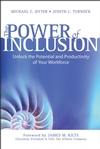
Book Review: The Power of Inclusion


Title: The Power of Inclusion: Unlock the Potential and Productivity of Your Workforce
Authors: Michael C. Hyter and Judith Turnock
Rating: 3.5 stars
Available: To purchase online and at various book stores.

With constantly advancing technology and increasing globalization, employee performance is what distinguishes top performing businesses from the rest. Hyter and Turnock highlight the aristocratic approach that many organizations take when deciding which employees are worthy of investing in, exclusively providing select employees with opportunities for advancement. They go on to explain how most management teams hire employees with characteristics similar to themselves, and solely focus training and development on those who they have deemed “high potential” employees. In a business world that is said to promote “equal opportunity” these common practices undoubtedly perpetuate inequality.

The authors make a business case for an inclusive model of human resource management. They detail how the people who are most successful in the workplace achieve their level of success because of the attention and amount of investment management has provided for them, not because they had more potential than any other employee. Subsequent chapters go on to explain how businesses can create an inclusive culture, concentrating development opportunities not just on the select few, but giving those same benefits to everyone; this will help them unlock the potential and productivity of their workforce.


Like
What stood out most for me was the section in the concluding chapter that highlighted assessment and evaluation guidelines to measure progress and results (p 230). The criteria include:


  • Increased breadth of recruitment

  • Increased internal sourcing and advancement

  • Increased diversity across the board

  • Reduced turnover

  • Improved employee satisfaction

  • Improved customer satisfaction

  • Increased market share

I also liked the index that highlighted important terms and topics, and the case studies weaved throughout the book which provided relevant information on real experiences.


Dislike
What I disliked about this book was that it seemed to focus on medium to large sized businesses. Also the turnaround time for measureable impact of the strategies proposed is fairly long. I think it would have been helpful for the authors included smaller, achievable goals throughout refurbishing process.


Lessons Learned
Don’t put all your eggs in one basket; equal opportunity includes providing every employee with training and development opportunities equally.

Monday, August 10, 2009

How to Maximize Your Talents at Work

Maximizing your talents and showing your employer your diverse set of skills can help to put you and your career in the spotlight. To maximize your talents you must recognize your own strengths. If you’re not sure what your strengths are, try asking friends and family “What do you think I’m good at?” You may also want to reflect on skills that you been complimented on. Next transfer the skills you identified to the realm of work.

Once you have identified your strengths and how they are applicable to work, it’s time to put these talents into action. Start by volunteering for projects or take initiative to help others when needed. Don’t be afraid to talk about your accomplishments with others in a non-boastful way. At staff meetings you could mention how much you enjoyed working on a certain aspect of a project. Or when offering to assist with certain projects, make note of your skills “I’m great at__________, and could really help with_________.”[1]


The potential benefits of maximizing your talents could result in focusing more on projects and job duties that are a better fit for you, in turn making work more enjoyable. Your willingness to volunteer for projects may be noted by your employer, who in turn may begin sending you the work you enjoy more often.


[1] http://www.playtoyourstrengths.com/resources/faiths-articles/maximize-your-talents

Thursday, July 16, 2009

Strategies for Working Successfully Within a Virtual Team


I’ve been working on virtual teams for several years now and recently started to think about some of the tools and techniques that I’ve seen used to effectively engage employees when there is little or no face-to-face (f2f) interaction. Some of the little interactions that we take for granted in a traditional work setting are not as easily replicated in a virtual work environment. In a traditional office setting, employees typically greet one another, even if it’s just a passing hello on the way to one’s desk. These settings allow for virtually endless opportunities to connect throughout the day whether it’s as they walk by colleagues on their way to another office, the lunch room, or just to stop by to check-in on a project. Then, of course, there’s the coffee/lunch room – a veritable meeting place for most workplaces.


With the ever-increasing advances of technology and the subsequent comfort people have using it, virtual or distance workers are becoming more commonplace. Some of the techniques I’ve seen for engaging virtual work teams are listed below:
  • Annual retreats, allowing staff to reconnect, build relationships, and engage in professional development opportunities
  • Regular team meetings (e.g., weekly teleconferences, audio conferences)
  • Regular project meetings using suitable communication technologies
  • Online document storage to ensure that all team members have equal access to required documents
  • Effective use of available communication technologies, including:
    • Telephone
    • Chat (e.g., MSN)
    • Videoconferencing using web cams (e.g., Skype)
    • Audio conferencing (e.g., GoToMeeting)
    • Email
    • Online planning software as a virtual white board (e.g., mywebspiration.com)
Some of the challenges that virtual teams may face, include:
  • Taking longer to build relationships and trust amongst team members
  • Misinterpreting electronic communications (e.g., email, telephone, audio conferencing, text chat) because of a lack of body language
  • Developing processes for communication and providing feedback amongst team members
Despite there being some challenges to working within a virtual team, there seem to be an endless number of benefits that this type of work arrangement can offer. Some benefits include:
  • Working with colleagues from other regions and countries
  • Enhancing one’s technology skills
  • Working flexible hours, particularly when a team is spread across various time zones
  • Saving money by not having to commute to an office (e.g., transportation, parking)
  • Decreasing wardrobe costs if working mostly from home
  • Experiencing a sense of well-being from lessening one’s environmental footprint
Although not an option for every workplace and not for every individual, I am happy that I’ve been able to work on virtual teams and experience the wonderful benefits of doing so!

Wednesday, June 10, 2009

"over-engagement"

When you hear about employee engagement, you likely think about how to ensure you increase and maintain high levels of engagement in the workplace...after all, studies show that engaged employees are more productive. However, do you ever think about whether your employees are over-engaged and the problems which may arise from over-engagement?

In reading a recent article about job loss and subsequent identity loss for some people, it became clear that it is possible for employees to become over-engaged in their work and over-identifying with their jobs. Workers with a great passion and interest in their work may be at risk for over-engagement.

The upside of over-engagement is that a job may not feel like work if the employee feels a personal connection and passion for the work. It may in fact feel like a dream job if personal and work interests are interconnected. On the surface these are likely attributes employers feel make positive contributions to their work sites.

Unfortunately, over-engaged workers may:
  • Identify strongly with their jobs thereby losing personal identity
  • Have unclear boundaries between work and personal life
  • Find it easy to sacrifice family, friends, and health for the sake of their jobs
In a turbulent economy, over-engaged individuals may be at risk of experiencing personal collapse if they lose their jobs. They may be more likely to experience workplace stress and burnout and the resulting stress-related illnesses can be incredibly costly to already over-burdened employees.

Here are some tips for ensuring employees aren’t over-engaged
• Make vacation mandatory
• Don’t make “busy a badge of honour”
  • Avoid rewarding those who work constant overtime and penalizing those who don’t
  • Employers should model valuing personal time by taking vacation, leaving early/on-time
  • Reward quality not quantity
  • Encourage volunteer work or involvement in community-based projects
  • Support health and wellness initiatives in the workplace
Life Strategies Ltd. offers a range of training opportunities, workshops, and services related to work-life sustainability, managing stress in the workplace, and healthy workplaces. For more information, visit: http://www.lifestrategies.ca/

Friday, May 8, 2009


Developing Essential Skills to Lead to Employee Engagement?

Do your employees have all the essential skills needed for their job? If not, there is a possibility that a lack of required essential skills could lead to a disengaged employee. Think about it; let’s say you are the manager of payroll services at a busy hospital; you have just hired Samantha on as she comes with great references for having excellent interpersonal skills. At the same time Samantha is hired, the department has just upgraded to a fancy new computer system. You make the assumption that as Samantha is pretty young she will easily transition to her position and easily learn the new computer system. After about a month you begin to notice that Samantha is already beginning to show signs of a disengaged worker: she has already phoned in sick, her morale is low, and there is room for improvement with her productivity. Samantha’s current behaviour is not reflecting the eager, enthusiastic employee you hired a month ago. There could be numerous factors which lead to an employee’s disengagement however one factor to think about is whether or not your employees have the necessary skills to do their job (i.e., would Samantha have been more engaged had she had more training on how to use the new computer system? Was the lack of knowledge and skill leading Samantha to be frustrated at work?)

The Government of Canada has identified nine essential skills that will benefit employees and help employees transition to change in their working environment. For a detailed description of the essential skills visit:
http://www.hrsdc.gc.ca/eng/workplaceskills/essential_skills/general/understanding_es.shtml

As an employer looking to increase employee engagement in the workplace a strong suggestion would be to assess the skills of your employees. If you feel that your employees could benefit from essential skills training – try to build in activities once a week that concentrate on enhancing the essential skills most needed by your staff.

Wednesday, April 29, 2009

Diversity and Employee Engagement

Living in Canada, we are surrounded by diversity – economic, geographic, cultural, and ethnic diversity. With all of this diversity in our midst, it is a bit of a wonder how society can at times be reluctant to embrace it. Perhaps I’ve become more attuned to the concept of diversity since it has been the subject of a recent project, but it seems that everywhere I turn these days, there is some mention of diversity – the cover of the current issue of Maclean’s Magazine, the upcoming focus of the next Contact Point newsletter, or the recent CANNEXUS conference.

After spending the past month steeped in a diversity project, I have come to appreciate the importance embracing diversity has on employee engagement in the workplace. For engagement to work from a diversity perspective, employees need to be able to bring their “whole self” to work, without any fear of how their disabilities, gender, sexual orientation, religion, ethnicity, age, etc. will affect how they are perceived. This in turn will allow employees to more fully engage with their job, increase productivity, and ultimately, lead to greater job satisfaction.

When an employee feels unable to come to work freely, without feeling emotions that could include discomfort, shame, dread, fear, this negatively impacts their ability to perform their work to their fullest potential. It seems that more and more companies are beginning to adopt or considering creating diversity policies and programs, recognizing that doing so is helpful to the bottom line. Because we live in a diverse society, hiring diverse workers and embracing our differences creates workplaces that better represent the diverse range of customers and clients, and will ultimately lead to increased employee engagement.

Tuesday, April 7, 2009

Engagement Through Charity

Life Strategies Ltd. is involved in numerous charity endeavours. Most recently we took part in Bowl for Kids Sake which raised funds for the Big Bothers Big Sisters organization. Here bowlers of all ages and abilities gathered up pledges from friends, family, and colleagues, laced up their rented shoes, and got their game face on for two adaptations of regular bowling - bingo and poker bowling. Since the theme was “Out of This World” there were many space inspired costumes with alien antennas, Star Wars outfits, and glowing jewellery adorning the bowlers. Although my personal bowling performance was not outstanding, I had a great time and knew that the money we raised would be put to good use.

This event was a great chance to give back to the community. According to the Big Brothers Big Sisters website they are “the nation’s largest youth mentoring organization providing quality adult mentoring services for over 26,000 children in more than 1,000 communities.”
Funds raised from the Bowl for Kids Sake will be used to support these mentoring programs.

Moreover, this is a great event for our team to get together. Since we all work electronically it’s not often that we are all in the same place at once. It was a great opportunity to re-energize and have fun while doing something worthwhile. These types of events keep us engaged in our work and our organization.

Be sure to check out the Bowl for Kids Sake website at
http://www.bowlforkidssake.ca/bowl4kids/default.asp to learn more about this event or to donate.

Thursday, April 2, 2009

Being 'Present' in Your Work

To me, career engagement is all about being ‘present’ in the work that you are doing. It is one thing to show up to work each day and complete the tasks required of you, but I think that it is another thing altogether to show up and give of yourself in such a way that you are contributing in the uniquely personalized way that only you can.

There is definitely a balancing act at play in terms of being ‘present’ in your work. We all have a wide range of roles that we are responsible for – parent, student, worker, caregiver, volunteer, coach, etc. It is unrealistic to assume that it is possible to be ‘present’ in all roles at all times. Instead, we can consciously strive to influence our environments so that we can maximize our presence in each of our roles.

Finding work that allows you to experience what Mihály Csíkszentmihályi calls Flow can certainly help. “Flow is the mental state of operation in which the person is fully immersed in what he or she is doing by a feeling of energized focus, full involvement, and success in the process of the activity”. http://en.wikipedia.org/wiki/Flow_(psychology)

Flow occurs when the right blend of skills and tasks come together and an optimal state is achieved. I only became aware of this concept over the last couple of years and I think it is worth further investigation and consideration. Understanding what is needed to achieve flow is a key component of engagement. I believe that an awareness of your optimal flow conditions is key to maximizing the feeling of career engagement.

To read more about Flow and Positive Uncertainty, check out these titles from Amazon.ca:
http://www.amazon.ca/Flow-Mihaly-Csikszent/dp/0061339202/ref=sr_1_1?ie=UTF8&s=books&qid=1238522328&sr=8-1
http://www.amazon.ca/Crisp-Creative-Decision-Positive-Uncertainty/dp/1560526904/ref=sr_1_3?ie=UTF8&s=books&qid=1238522636&sr=8-3