Showing posts with label diversity. Show all posts

Tuesday, June 28, 2011

The Synergy of Teams


People are constantly asking me how I do all that I do – my response invariably is that “I have a great team!”

At its simplest, synergy is defined as “two or more things functioning together to produce a result not independently obtainable.” Research has demonstrated that synergistic teams can out-produce even the most talented member – and we’ve seen that over and over within the Life Strategies teams.

There is strength in diversity – at Life Strategies, we deliberately build teams that comprise individuals with different competencies and styles. This, of course, means that we all have to embrace and appreciate diversity. Sometimes it’s easier to work with people who approach tasks the same way or share a very similar perspective. However, by choosing to surround ourselves with people who see the world differently and bring unique skills and talents we minimize our blind spots and maximize our productivity.

Do you really know the strengths and talents on your team? Do you let people do what they do best . . . and try to accommodate their weaknesses? Or, are you trying to do too much independently – spending hours at tasks that others could do better in a fraction of the time?

Tools like Personality Dimensions® can help you better understand the teams you work with – whether at work, in athletics, or on community boards. Most members of the Life Strategies team are Personality Dimensions facilitators or Master Trainers . . . aside from facilitating workshops, though, we all walk our talk – celebrating the diversity on our team and providing opportunities for each other to do what they do best. Contact us at info@lifestrategies.ca if you’d like to introduce your own team to this amazing tool.

Friday, May 27, 2011

Immigrant or Expatriate? There's a Difference

Some people think that anybody working in Canada who’s “from away” is an immigrant – but that’s not always the case. However, we rarely think of Canadians working abroad as having emigrated (i.e., left Canada permanently). Instead we consider them expatriates. This is an interesting shift in perspective, with all sorts of career/life implications.

Expatriates, international workers, or global careerists typically live a somewhat privileged lifestyle compared to locals; immigrants, on the other hand, typically struggle to get their careers back on track. Ironically, so do some people repatriating to Canada – although their careers may have blossomed abroad, similar to many immigrants they have a hard time convincing local employers that their international experience is of value.

Within Canada and many developed countries, when someone new to the country requests career services, there is often a focus on language training, skills upgrading, and, in some cases, complete re-careering. It’s not unusual to find an immigrant with a PhD driving taxi or serving in a restaurant. I once had a medical doctor from Afghanistan tell me that, upon arrival in Canada, he’d been told that he would have to work as a dishwasher here!

It astounds me that anyone would be surprised when a foreign-trained worker leaves Canada for better opportunities somewhere else. If I was to emigrate from Canada (i.e., immigrate to another country which was to be my permanent home), then it would be worth my time to learn the language and customs, upgrade my education, gain local job search skills, and take a survival job as I settled in. On the other hand, if I were to go to a foreign country where I'd heard that they needed people with my existing professional skills (e.g., teaching counselling in a university; corporate training for a multinational corporation), if I couldn't get that type of work within a very short period of time after arrival, there'd be no point in staying. I'd move to another country that could use my skills.

International/global careerists change countries in a similar way as people in a large city take on new jobs throughout the region. Within the Vancouver area, for example, someone might accept a job offer in Burnaby even if he or she lives downtown. The individual may commute rather than move to Burnaby. Even if a decision is made to move to Burnaby, once the contract is finished it’s quite likely that he or she will move again for the next job. So too, international workers go where the work is. They may leave family behind or families may relocate temporarily; children may attend local or international schools. Leisure time may be spent with other expatriates, groups from “home,” locals, or a combination.

Unfortunately, in Canada, we tend to view all people with foreign accents as "immigrants." However, the needs and expectations of immigrants are significantly different from the needs and expectations of people with international careers (or expats). Interested in learning more? Life Strategies offers relevant courses for career practitioners on The Immigrant Experience and International/Global Careers. Contact studentadvisor@lifestrategies.ca for more information.

Wednesday, April 27, 2011

Diversity – Experiencing What It’s Like to Be Different

When we think of diversity, we tend to think of what’s different about others. We typically use our own characteristics as benchmarks – particularly if we’re part of the mainstream population (i.e., if we’re surrounded by lots of other people quite similar to us). However, have you ever turned the tables and paused to consider what is different about you? What do others consider unusual or out-of-the-norm? What characteristics, attitudes, or behaviours do you have that others think are a little bit strange?

Gerry and I travel extensively, which provides lots of opportunities for us to reflect on being different, particularly in terms of nationality, race, ethnicity, religious beliefs, language, and culture. As a very pale-skinned redhead, there are many places in the world where I stand out like a white shirt under a black light – I pretty much glow in the midst of a sea of darker skin and hair (redheads are a global minority, losing ground quickly – currently thought to comprise only 1 - 2% of the world’s population). However, it’s rare that our difference is perceived as a disadvantage; I, therefore, can’t say I’ve experienced the types of extreme prejudice and discrimination that many other minorities encounter every day.

When we’re in foreign countries, we’re constantly reminded of our incompetence. No matter how prepared we try to be, we can never use local transit as effectively as the locals. We are slow to count out payment for a purchase. We stumble over words to request the simplest things. And, just like foreigners anywhere, we miss the familiar items and foods from “home.”

My experience as a foreigner is very different when I’m an invited subject matter expert than when I’m an anonymous traveller. In the first role, I often have people who prepare for my arrival and ensure that I’m comfortable, safe, and taken care of. In the latter role, I’m more likely to be teased, laughed at, or taken advantage of – it’s clear that many people find “different” strange and not something to aspire to. In Northern China, I lost count of the number of people trying to sell me a solution to fix my freckles (I didn’t realize they were a problem before then). In a remote region of Malaysia, well off the typical tourist track, a small child cried every time her mother brought her within 6 feet of me (she’d never seen a white-skinned person with flaming red hair before). In Marrakesh, accepting an offer of tea resulted in the expectation that we’d purchase a Berber carpet (we learned from that one – this is similar in many parts of the world!).

In the Canadian workplace, we constantly encounter difference and we’re asked to embrace it. However, sometimes we’re “colour-blind” and simply don’t realize the discrimination and challenges that our diverse colleagues encounter every day. To increase your awareness, I encourage you to put yourself in the position of being the outsider – attend cultural celebrations, travel, volunteer at a community event that’s outside of your normal routine, use a form of local transit that you’re unfamiliar with, eat dinner at a restaurant frequented by members of a different ethnic group, accompany a local family to the food bank, or spend a day on the street with a homeless person. Be different to learn about difference. Then support diversity initiatives in your workplace to ensure that those perceived as different have a safe place to fully contribute their talents.

Interested in learning more about diversity? Life Strategies has a variety of courses, including:

Wednesday, February 9, 2011

Workplace Conflict


Conflict can be distressing in the workplace. A quick Google search for “workplace conflict 2011” revealed almost 59 million hits, including recent research from the UK, courses in Canada and Australia, blogs, headlines about workplace violence, and articles targeted to diverse industries and organizational structures. Workplace conflict is a hot topic!

In many cases the conflict is amongst co-workers or between employees and their managers and someone from the Human Resource department may be called in to intervene. Left to simmer too long, minor workplace conflicts can boil over, resulting in toxic workplaces, bullying, mobbing, or, in extreme cases, a violent counter-attack as in the Calgary story from just last month, where an employee, frustrated over a disagreement about expenses, rammed a semi-trailer into his employer’s truck. Witnesses reported, “He was distraught . . . he could have done anything!”

In other cases, however, conflict initiates with dissatisfied customers or disempowered clients. Regardless of the issue or who the players may be, de-escalating conflict is an important skill to have. We’ve recently uploaded 10 Tips for De-Escalating Conflict and it’s a key component of our customized workshop for case managers on “Dealing With Challenging Clients.” Tips focus primarily on managing yourself – the only person in the conflict that you really have any control over!

Join us online for our new online certificate program for Case Managers, beginning February 16th!

Tuesday, October 26, 2010

Learning from Diversity


On the West Coast of Canada, we are surrounded by diversity. I live in a village just an hour from Vancouver – our community is rural, much of the local work is agricultural. Some of our neighbours have lived here for generations; others have recently arrived from India, Viet Nam, Mexico, or China. There’s a Vietnamese Buddhist Monastery on the corner of our street and the first Mormon Temple in BC nearby. Along with countless Christian churches, a Sikh temple is also an important spiritual centre for many members of the community.

Sadly, however, members of each of the ethnic communities tend to live in isolation. Although children attend the same public schools, many other community activities tend to be less integrated. Of course there are a few intersections – for example, the produce market that I shop at has an extensive selection of ethnic foods from India, Mexico, and Germany. However, even most workplaces are quite homogenous – resulting in many local residents never learning to speak one of our official languages (in the West, more typically English than French).

Within the Life Strategies team, we speak and write about diversity and have developed tools to support diverse workplaces (e.g., www.embracingdiversity.ca or www.diversityatwork.ca). We teach courses on Managing Diversity, Understanding Diversity, Global/International Careers, and The Immigrant Experience and have a multicultural specialist stream in our Career Management Professional Program (http://www.lifestrategies.ca/services/courses/career-management-professional-program-cmpp.cfm). It continues to amaze me, however, that the students we attract to those courses tend to be those who themselves come from minority cultures, have immigrated to our area, or are already working with immigrant clients. It’s difficult to reach “mainstream” students...

The 4 Stages of Learning Model reminds us that we simply don’t know what we don’t know. Therefore, until we experience the benefits of diversity at a personal level, we likely won’t choose to learn more about it or advocate for more inclusive workplaces or communities. I’ve recently returned from attending the Jiva conference in India – Jiva means “life” - the photo on this blog is me arriving by auto-rickshaw on the first day of the conference. The conference was co-sponsored by the Promise Foundation in India and the International Association of Educational and Vocational Guidance. There were 442 delegates from 32 countries – many of them knew nothing about Canada, just as I humbly realized I knew very little about most of their countries.

On our return from India, we visited the World Expo in Shanghai, China, with contributions from more than 242 countries and international associations. Think about that number! Gerry and I have visited, lived, or worked in only 55 countries (and, that’s quite high compared to most people we know). In 3 days, it wasn’t possible to visit more than a few of the pavilions, but we learned much about countries and cultures that we knew little about before. As a result, we’ve been inspired to add Kazakhstan to our future travel list – their pavilion was great!

So...how can you learn from diversity? First, I encourage you to put yourself in a position of being a minority. Take opportunities to travel (and don’t stay only in Western hotels or all inclusive resorts – mingle with the locals!). If travel isn’t feasible, eat at ethnic restaurants, attend cultural events or festivals, read books (I’ve just finished Echlin’s “The Disappeared” about Cambodia), or take a course that will help you better understand the amazing gifts that diversity brings to our lives in Canada.

Thursday, August 12, 2010

Building Cultural Competency...Right in Your Own Neighbourhood

Managing diverse workplaces is a hot topic these days. To address skill shortages, we’re increasingly dependent on immigrant workers – and, for the first time ever, we have four distinct generations working within many organizations. Much money and time has been invested in helping organizations to recruit and retain diverse workers – the SEED toolkit that we developed last year is one example of a comprehensive project with that focus. The toolkit is freely available at: www.embracingdiversity.ca.
However, a big challenge with embracing diversity is simply that we don’t know what we don’t know. In the Cultural Diversity Yearbook, part of the SEED toolkit, is full of ideas for embracing diversity at work.
The picture I’ve inserted here looks like it might be from one of our trips to Asia, doesn’t it? A beautiful Jade Buddha is being admired by visitors, some of whom have travelled quite a distance to see it. If you could hear the sounds, the major languages are Chinese and Vietnamese – no English. You’d smell incense mingled with Pho, a Vietnamese soup. Many visitors are drinking bubble tea. There are only 4 Caucasian visitors out of several hundred in the plaza – Gerry and I, and two men with their Asian wives and families.

What may surprise you is that this photo is from the corner of our quiet street in the village of Aldergrove, in the middle of farm country just an hour outside of Vancouver. A Buddhist monastery purchased the United Church building and property and, within just one month, converted it to a temple. The
Jade Buddha for Universal Peace is only temporarily on display – if you can get to Aldergrove before Sunday, August 15th, it’s well worth a look!

As I sat at my desk earlier today and looked out my office window, a South Asian woman was standing on her front lawn bowing to the East in the early morning light (different culture and different faith from the Buddhists on the corner). Last weekend, about 8,000 Christian youth attended “Rock the River” just a few kilometres west of here. We took our grand-daughters to the Chilliwack agricultural fair last Friday, too!

Without straying far from home this summer, what cultural events can you attend? Once you’ve explored a bit, consider celebrating the diversity within your own workplace – a cultural potluck can be a wonderful start! The
Cultural Diversity Yearbook, part of the SEED toolkit, is full of ideas for embracing diversity at work.

Interested in learning more about the SEED toolkit and other workplace diversity resources? Join us online for one week beginning September 22 for our Managing Diversity e-course!

Monday, May 10, 2010

Macleans magazine reports that the top rated employers in Canada provide parental-leave top-ups, tuition subsidies, flex hours, tele-commuting, job sharing, and occasionally the opportunity to make their own hours, judged on output instead of physical hours (October 19, 2009).
Experts say that appreciation and opportunity for growth and development are the most important factors in job satisfaction. It’s really not about the money.
Interestingly, the summer 2009 edition of Fibromyalgia Aware states that the accommodations listed above are precisely what persons with disabilities require to be active in the workforce (p24).
As a career community we have been researching and studying diversity in the workplace. There are programs to educate employers and employees about promoting diversity in the workplace; however, I wonder how often disabilities are considered to be a type of diversity? Are workplaces prepared to make accommodations? Are folks with ALL types of diversity being welcomed into the work-place and being given the opportunity to grow and develop?
I have a disability and am fortunate enough to have an employer who provides the opportunity to work from home and to determine my own hours. Such flexibility and understanding helps keep me engaged in my work, and provides me with a sense of satisfaction.
When Sigmund Freud was asked what he considered to be the most important characteristics of an emotionally healthy adult, he answered simply, “To love and to work.”

Thursday, January 7, 2010

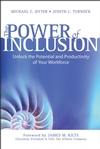
Book Review: The Power of Inclusion


Title: The Power of Inclusion: Unlock the Potential and Productivity of Your Workforce
Authors: Michael C. Hyter and Judith Turnock
Rating: 3.5 stars
Available: To purchase online and at various book stores.

With constantly advancing technology and increasing globalization, employee performance is what distinguishes top performing businesses from the rest. Hyter and Turnock highlight the aristocratic approach that many organizations take when deciding which employees are worthy of investing in, exclusively providing select employees with opportunities for advancement. They go on to explain how most management teams hire employees with characteristics similar to themselves, and solely focus training and development on those who they have deemed “high potential” employees. In a business world that is said to promote “equal opportunity” these common practices undoubtedly perpetuate inequality.

The authors make a business case for an inclusive model of human resource management. They detail how the people who are most successful in the workplace achieve their level of success because of the attention and amount of investment management has provided for them, not because they had more potential than any other employee. Subsequent chapters go on to explain how businesses can create an inclusive culture, concentrating development opportunities not just on the select few, but giving those same benefits to everyone; this will help them unlock the potential and productivity of their workforce.


Like
What stood out most for me was the section in the concluding chapter that highlighted assessment and evaluation guidelines to measure progress and results (p 230). The criteria include:


  • Increased breadth of recruitment

  • Increased internal sourcing and advancement

  • Increased diversity across the board

  • Reduced turnover

  • Improved employee satisfaction

  • Improved customer satisfaction

  • Increased market share

I also liked the index that highlighted important terms and topics, and the case studies weaved throughout the book which provided relevant information on real experiences.


Dislike
What I disliked about this book was that it seemed to focus on medium to large sized businesses. Also the turnaround time for measureable impact of the strategies proposed is fairly long. I think it would have been helpful for the authors included smaller, achievable goals throughout refurbishing process.


Lessons Learned
Don’t put all your eggs in one basket; equal opportunity includes providing every employee with training and development opportunities equally.

Tuesday, September 8, 2009

Book Review: Crucial Conversations

Book Review


Title: Crucial Conversations: Tools for Talking When Stakes are High
Authors: Kerry Patterson, Joseph Grenny, Ron McMillan, and Al Switzler
Rating: 4 stars out of 5
Available Online
[1]
For more than 25 years, Patterson, Grenny, McMillan, and Switzler researched people in the workplace. These authors found that what makes someone an effective colleague is the way they manage their conversations. The authors studied these conversations and took detailed notes when they were having crucial conversations.
The authors offer some basic steps for how to manage crucial conversations. First is to identify when a conversation is turning crucial. One way to do this is by your own physical signals (e.g., Is your stomach getting tight? Are you eyes drying up?).


Once a crucial conversation is recognized the authors suggest to “start with heart.” What this means is to dig deep down inside and figure out the message you’re truly trying to get across. Often in a crucial conversation you can become defensive and your message may get lost or never get sent because the focus turns to defending. If you can recognize that a conversation has turned crucial and stay focussed, then you can learn to avoid being defensive and stay focussed on the message you’re really trying to get across. If your conversation partner begins to get defensive, this is one way to recognize that they do not feel safe in the conversation. When someone is feeling unsafe, they are likely not hearing your purpose. To return to a safe conversation, the effective conversationist has to guide the conversation back to a mutual purpose; if both parties can agree on one goal, it makes the conversation safer, with both parties more likely to hear what one another has to say.


Like

One of the best things about this book is the use of examples for various situations. This book is not just useful in a work setting, but also applies to conversations with spouses, family members, and friends.


Dislike

The authors did a very good job of getting the point across in the first few chapters, however after that the advice seemed a bit repetitive.

Lesson Learned

Practice makes perfect. Just as trying to remember to sit with good posture may take a conscious effort so too does staying in tune to your emotions during conversations when they turn crucial. It’s easy to prepare yourself for a crucial conversation when you are expecting one, but as conversation escalates and emotions get stronger, it is easy for conscious effort to control your emotions to fade. Just as you may sit down extend your back, put your shoulders back, and focus on good posture, once you begin working on something you may realize a few minutes later your back is slouched and your shoulders are forward. If you are in the middle of a crucial conversation and you suddenly become aware that your emotions have taken over, take a few minutes to regain your composure, take some deep breaths, and start back into the conversation. Over time, forming some of the habits in this book should become natural just as good posture is more natural for someone that practices at it, such as a ballet dancer or physiotherapist.

[1] http://books.google.ca/books?id=Gzjj9mSPAGEC&dq=crucial+conversations+tools+for+talking+when+stakes+are+high&printsec=frontcover&source=bl&ots=Aj8gIPH8II&sig=oq_qTIeUhEF9MyKeOjy3grtvEB8&hl=en&ei=RvOWSo_cG4ySsgPhocXFDA&sa=X&oi=book_result&ct=result&resnum=1#

Thursday, May 21, 2009

Involving Employees in Diversity Initiatives


Employers are slowly coming to seeing the advantages of creating a diverse workforce and fostering an organizational culture which accepts and supports individuals from diverse backgrounds. Diversity makes good business sense for a lot of reasons including reducing turnover/absenteeism, fostering creativity/innovation, and improving marketplace understanding (Robinson and Dechant (1997) as cited in HRM Business Case for Diversity Management -http://www.managementmarketing.unimelb.edu.au/mcib/include/diversity/HRM%20Business%20Case%20for%20Diversity%20Management.pdf). It can also foster employee engagement by creating a safe and accepting workplace.

But what about actually involving employees in creating and organizing workplace diversity initiatives? What about creating “diversity champions” or “diversity committees” to spear head such initiatives? These are individuals or groups of individuals who are the “go to” people for anything related to diversity. They can be just regular employees, not experts, who have a passion for diversity and know where to look or who to consult with to get the answers you need.

Begin a “diversity champion” or on a “diversity committee” offers employees a chance to get involved by shaping organizational culture and improving diversity within the organization. It also provides the opportunity for employees to get involved in something they really care about. Perhaps they’ve been itching to help orientate newcomers into the working environment but never had the opportunity or perhaps they are a newcomer themselves and empathize with the challenges newcomers can face drawing on their own personal experiences. Whatever the case may be, getting involved in diversity initiatives is a great employee engagement strategy.

Wednesday, April 29, 2009

Diversity and Employee Engagement

Living in Canada, we are surrounded by diversity – economic, geographic, cultural, and ethnic diversity. With all of this diversity in our midst, it is a bit of a wonder how society can at times be reluctant to embrace it. Perhaps I’ve become more attuned to the concept of diversity since it has been the subject of a recent project, but it seems that everywhere I turn these days, there is some mention of diversity – the cover of the current issue of Maclean’s Magazine, the upcoming focus of the next Contact Point newsletter, or the recent CANNEXUS conference.

After spending the past month steeped in a diversity project, I have come to appreciate the importance embracing diversity has on employee engagement in the workplace. For engagement to work from a diversity perspective, employees need to be able to bring their “whole self” to work, without any fear of how their disabilities, gender, sexual orientation, religion, ethnicity, age, etc. will affect how they are perceived. This in turn will allow employees to more fully engage with their job, increase productivity, and ultimately, lead to greater job satisfaction.

When an employee feels unable to come to work freely, without feeling emotions that could include discomfort, shame, dread, fear, this negatively impacts their ability to perform their work to their fullest potential. It seems that more and more companies are beginning to adopt or considering creating diversity policies and programs, recognizing that doing so is helpful to the bottom line. Because we live in a diverse society, hiring diverse workers and embracing our differences creates workplaces that better represent the diverse range of customers and clients, and will ultimately lead to increased employee engagement.